Posts mit dem Label 1988 werden angezeigt. Alle Posts anzeigen

Sonntag, 15. September 2013

Linol-Tarot

Creator(s): Gerhard Haack
Date: 1988
Country: Germany

Publisher: self-published 
Number of Cards: 79
ISBN:    

Type: RWS
Reference:
Encyclopedia of Tarot, vol. IV, pp.401, 403


Notes:
The deck is printed as "Linol-Farbdruck", that means not the black lines (which are line drawings), but only the five different colors were applied as linoleum block prints.

The minors were fully illustrated, they are inspired by the RWS images but not clones. The cards have German titles and Roman numbers, Strength is 8, Justice 11.


The deck has 78 cards plus an untitled extra card showing a man with a club.

It is a limited edition of 150 decks. The cardboard box of the deck is signed and numbered by the artist, mine is number 123. There is no lwb.


Sonntag, 1. September 2013

Elemental Tarot (Smith)

Creator(s): Caroline Smith, John Astorp
Date: 1988
Country: USA

Publisher: Dolphin Doubleday
Number of Cards: 78
ISBN: 0-385-24726-5   

Type: other
Reference: 
Encyclopedia of Tarot, vol. III, pp. 193, 194


Notes:
John Astrop is an astrologer and writer, and Caroline Smith is a painter and tarot reader. The Elemental Tarot fits a system of astrological combinations to the 78 cards of the Tarot. The card designs are vertically divided at the point of the golden section.

There are several symbols printed within the borders of each card. The suits are renamed. Earth refers to pentacles, air to swords, fire to wands, and water to cups. The corresponding elements are symbolized at the bottom by one of five geometric shapes. These five shapes are actually the Tattwa symbols. The Trumps are noted by an egg shape which corresponds to Spirit, the suit of Fire by a red triangle, Air by a blue circle, Water by a silver moon, and Earth by a green square.

Each card is also assigned a pair of planets which is meant to give additional meanings. This system of correspondences does not use the twelve zodiacal signs, but instead uses the ten planets, the midheaven, the ascendant, and Moon's node. The total pair combinations possible equal seventy-eight.

The Major Arcana are titled at the top, and have a descriptive keyword at the bottom. Some retain their traditional titles, such as The Sun, The Star and The Fool, others have been renamed, the Magician, for example,  is called the Trickster, it is the Pope instead of High Priest, and Aeon instead of the World. Within the side margins are lines from a Gnostic poem titled The Thunder, Perfect Mind. This text was one of several documents comprising the Nag Hammadi discovery in 1945.

Each Minor Arcana card is titled with an elemental based keyword and includes the name of a god or goddess from a variety of cultures at the bottom. The symbols found in the lower left margin of the Minor Arcana are Egyptian  hieroglyphs.

The court cards are Father, Mother, Son and Daughter and correspond to the traditional King, Queen, Knight and Page.

This is the first edition from 1988, which has sturdy slipcase packaging which houses a boxed set of cards and a hardbound book.The later edition by St.Martin'sPress in 1999 is of inferior quality.

Montag, 14. Januar 2013

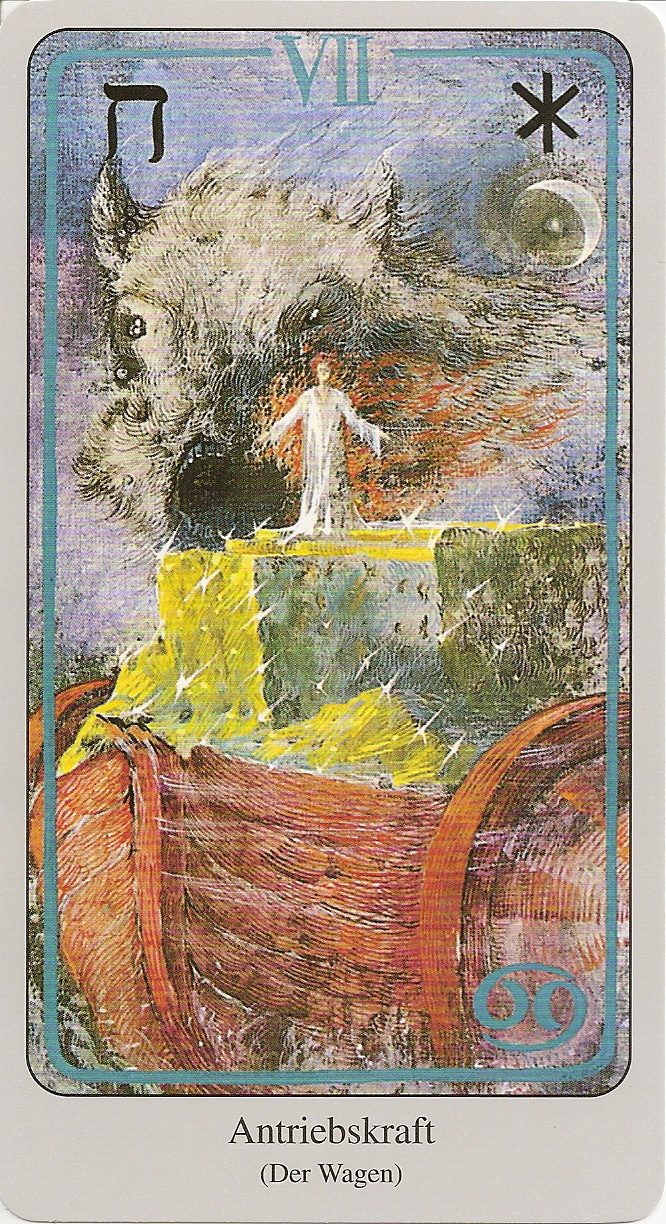
Haindl Tarot


Creator(s): Hermann Haindl, Rachel Pollack
Date:
1988 / 2002
Country:
Germany
Publisher:
Droemer Knaur / Lotus
Number of Cards:
78
ISBN:
978-3-7787-8044-2

Type: Thoth
Reference:
Encyclopedia of Tarot, vol. IV, pp. 374-375


Notes:
The original, large-format (8,5 cm x 15,5 cm) printing of Herman Haindl's  tarot was published by Droemer Knaur in 1988 as a German only version. Mine is a 2002 reprint of this version  by Lotus . There also was a smaller edition by US Games in 1990.

The non-reversible back design shows a single eye

The Haindl Tarot has non-traditional imagery and is strongly influenced by the Crowley-Harris Thoth Tarot. There is a complicated system of correspondence, each of the Majors has been given Qabalistic, runic and astrological designators.

Number / Card / Hebrew Letter / Rune / Astrological Sign / Element (from Rachel Pollack's book)

0 The Fool Aleph (Ox) Wynn (Joy) Uranus Air
1 The Magician Beth (House) Peoh (Cattle) Mercurry Air
2 The High Priestess Gimel (Camel) Ur (Aurochs) Moon Water
3 The Empress Daleth (Door) Thorn (Thorn) Venus Earth
4 The Empress Heh (Window) Ansur (Mouth) Aries Fire
5 The Hierophant Vav (Nail) Radh (Wheel) Taurus Earth
6 The Lovers Zain (Sword) Ken (Torch) Gemini Water
7 The Chariot Cheth (Fence) Hagall (hailstone) Cancer Water
8 Strength Teth (Snake) Sigil (Sun) Leo Fire
9 The Hermit Yod (Hand) Is (Ice) Virgo Earth
10 Wheel of Fortune Kaph (Palm) Jara (Year) Jupiter Fire
11 Justice Lamed (Ox goad) Nyd (Necessity) Libra Air
12 The Hanged Man Mem (Seas) Tyr (God of war and law) Neptune Water
13 Death Nun (Fish) Ba (Birch Goddess) Scorpio Water
14 Alchemy Samekh (Tent peg) Laguz (Water) Sagittarius Fire
15 The Devil Ayin (Eye) Eolh-elk (Man) Capricorn Earth
16 The Tower Peh (Mouth) Yrr-err (Woman) Mars Fire
17 The Star Tzaddi (Fishhook) Eh (Horse) Aquarius Air
18 The Moon Kaph (Back of head) Othal (Prosperity) Pisces Water
19 The Sun Resh (Head) Gebo (Gift) Sun Fire
20 Aeon Shin (Tooth) Peoh (dice cup) Pluto Fire
21 The World Tav (Signature) Gebo (Gift) Saturn Earth


The Minors represent South and ancient Egypt (swords), East and Hinduism (wands), North and ancient Norse/Celtic Europe (cups) and West and Native America (stones). Each of the numbered Minors includes an I Ching hexagramm. The court cards are father, mother, son and daughter. The inner borders are white for air, blue for water, red for fire and yellow for earth.

The central theme of this deck, as reported by Rachel Pollack, is "the renewal of the Earth - not just the material resources, but the spiritual Earth."


Mittwoch, 29. Februar 2012

The Herbal Tarot

Creator(s): Michael Tierra, Candis Cantin
Date: 1988, reprint 2011
Country: USA
Publisher: US Games
Number of Cards: 78
ISBN: 978-0-88079-332-2
Type: RWS
Reference: Encyclopedia of Tarot, vol. III, pp. 587, 592-593


Notes:
The Herbal Tarot follows the general assignments of the Rider-Waite deck, but each card is assigned an individual medicinal herb.

Each suit is associated with a body system. Swords correspond to air and emotions, so all the herbs used in the suit of swords are herbs that affect the respiratory or nervous systems. Wands correspond to fire, energy and blood, herbs used in the suit of wands affect the heart and circulatory system. Cups are water, the herbs on cup cards affect the urinary and reproductive system, including aphrodisiacs. Pentacles represent earth, pentacle herbs affect the digestive system.

Some of the Major Arcana are renamed: The Hierophant is called the High Priest, The Wheel of Fortune is renamed the Medicine Wheel, the Hanged Man is the Suspended One and the Devil has be renamed as Pan.

Each card is labeled at the bottom. Trumps and court cards are labeled in capital letters on a grey background, pip cards are labeled in upper and lower case on a white background. All cards have a white border. The common name of the herb that is used on the card appears in script at the top of the card. When the background is dark, the script is light, when the background is a light color, the script is black.

Dienstag, 7. Februar 2012

Jungian Tarot

Creator(s): Robert Wang
Date: 1988, reprint 1991
Country: Switzerland
Publisher: Königsfurt Urania
Number of Cards: 78
ISBN: 3-921960-73-8
Type: Golden Dawn
Reference: Encyclopedia of Tarot, vol. IV, pp. 386, 390-391


Notes:

Rober Wang calls the deck "a set of precisely interrelated images designed on jungian principles for a method which Jung described as active imagination". It is based on opposites , male and female.

Each of the Major Arcana has at its base a mandala.